


Kesi vs. Embroidery vs. Brocade: What's the Difference?
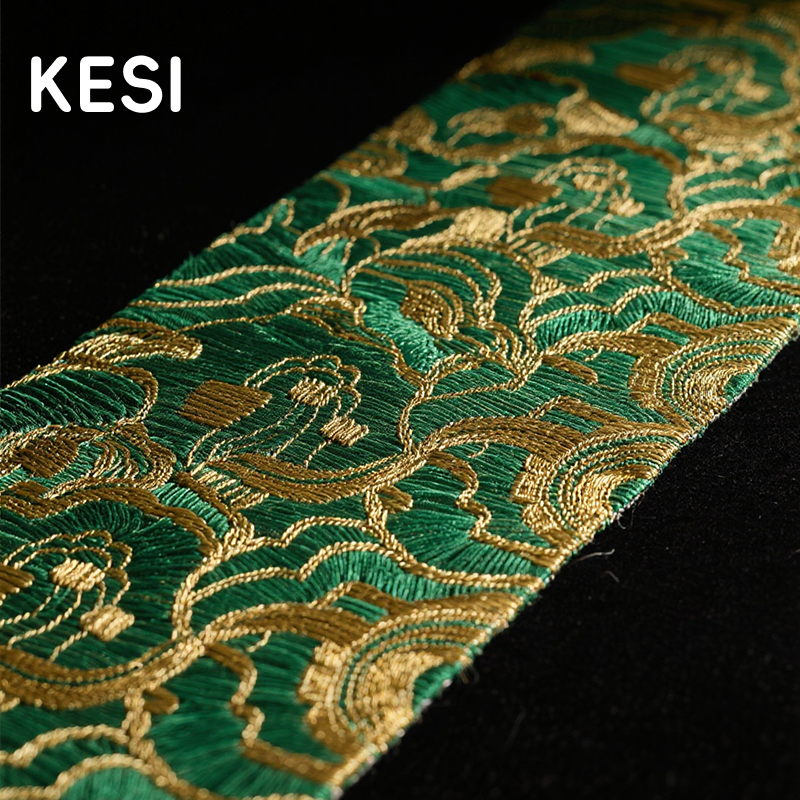
Chinese silk arts are often grouped together, but kesi, embroidery, and brocade are three genuinely different crafts — different in how they're made, how they look, and how much they're valued. Confusing them is easy; telling them apart is simple once you know what to look for. This guide breaks down kesi vs. embroidery vs. brocade so you can recognize each at a glance.
Quick answer: The difference is in how the color and pattern get into the cloth. Kesi (缂丝) is a tapestry weave where the image is woven in block by block, creating a reversible fabric with tiny "carved" slits between colors. Embroidery (刺绣) is stitched on top of an already-finished ground, so it has a right and wrong side and a raised, textured surface. Brocade (锦) is woven with continuous patterned weft threads, producing repeating woven patterns. Quick test: kesi is reversible with slit edges; embroidery is stitched on top; brocade shows woven repeats.
Three Ways to Put a Picture in Silk
All three crafts decorate silk, but the method is what separates them:
- Kesi — woven in (tapestry). The image is built during weaving, color area by color area. The picture is the fabric.
- Embroidery — stitched on. A finished silk ground is decorated afterward with needle and thread stitched over the surface.
- Brocade — woven with patterned wefts. The pattern is woven in using additional continuous colored threads that float and interlace to form repeating motifs.
Keep that trio in mind — woven-in vs. stitched-on vs. woven-with-patterned-thread — and the rest of the distinctions follow naturally.
Kesi: The "Carved Silk" Tapestry
Kesi is a tapestry technique where colored wefts are woven back and forth only within their own color zones. Its hallmarks:
- Reversible: identical on both sides, because the image is woven into the fabric with no threads carried across the back.
- "Carved" slits: fine gaps between color areas that look incised in the light.
- Painting-like: capable of extraordinarily fine, gradient detail — historically used to reproduce paintings and calligraphy.
- Extremely slow: woven block by block, so a piece can take months.
If a silk picture is reversible and shows slit edges between colors, it's kesi.
Embroidery: Stitched on Top
Embroidery (刺绣) — including famous traditions like Suzhou embroidery — decorates a finished ground with stitches:
- Right and wrong side: the front shows the design; the back shows thread paths, knots, or a lining.
- Raised texture: stitches sit on top of the cloth, giving a tactile, dimensional surface.
- Stitch variety: different stitches create different textures and sheens.
- Applied, not woven: the base cloth exists first; the picture is added after.
If the design is raised and textured on a one-sided cloth, it's embroidery — not kesi.
Brocade: Woven With Patterned Threads
Brocade (锦) — such as Song brocade or Yun brocade — weaves the pattern in using extra colored weft threads:
- Woven repeats: patterns are typically regular and repeating (geometric motifs, medallions, florals).
- Structured, often denser fabric: brocade tends to be more substantial than a plain weave.
- Continuous wefts: unlike kesi, the patterning threads run across the fabric, sometimes floating on the back.
- Usually one main face: the front shows the finished pattern; the back may show floats.
If the silk shows a rich, repeating woven pattern and is denser and structured, it's brocade.
Side-by-Side Comparison
| Kesi (缂丝) | Embroidery (刺绣) | Brocade (锦) | |
|---|---|---|---|
| How pattern is made | Woven in, block by block | Stitched on top of finished cloth | Woven with continuous patterned wefts |
| Both sides | Identical / reversible | Right & wrong side | Usually one main face |
| Surface | Flat, painting-like | Raised, textured stitches | Woven, sometimes floats on back |
| Signature look | "Carved" slits between colors | Dimensional stitch texture | Repeating woven motifs |
| Speed / rarity | Very slow, very rare | Ranges widely | Slow, but faster than kesi |
The quickest single test: turn it over. Reversible with slits = kesi; distinct back with stitches = embroidery; woven pattern with possible floats = brocade.
Why It Matters When You're Buying or Appreciating
Knowing the difference helps you value and care for a piece correctly:
- Value: Kesi is generally the rarest and most labor-intensive of the three, which affects price and collectibility.
- Authenticity: Sellers sometimes use these terms loosely. Recognizing the real technique protects you from mislabeled pieces.
- Care: All are silk and dislike sunlight, humidity, and snagging — but embroidery's raised stitches and kesi's reversible weave each reward slightly different handling.
- Appreciation: Understanding the craft deepens your enjoyment — you see not just a pattern, but the method and mastery behind it.
Whether collecting textiles or choosing kesi-inspired jewelry, knowing which craft you're looking at lets you appreciate it fully.
Explore YIEON's Kesi Collection
Every YIEON kesi silk piece is crafted by hand and presented with its cultural story. A few pieces to explore:


Frequently Asked Questions
What's the difference between kesi and embroidery?
Kesi is a tapestry weave where the image is woven into the fabric (reversible, with "carved" slits between colors). Embroidery is stitched on top of already-finished cloth, giving a raised texture and a distinct right and wrong side.
How is kesi different from brocade?
Kesi weaves each color area separately, block by block, producing painting-like detail and a reversible fabric. Brocade weaves patterns using continuous patterned weft threads, producing repeating woven motifs and usually one main face.
What's the quickest way to tell them apart?
Turn the piece over. Kesi is identical on both sides with slit edges; embroidery has a stitched, one-sided surface; brocade shows a woven repeating pattern, sometimes with thread floats on the back.
Which is the rarest and most valuable?
Kesi is generally the rarest and most labor-intensive, woven slowly block by block — hence the saying that an inch of kesi is worth an inch of gold.
Is kesi a type of embroidery?
No. Kesi is a woven tapestry technique — the image is part of the weave. Embroidery is added on top of finished cloth with a needle. They're fundamentally different crafts.
What are examples of Chinese brocade?
Song brocade (Suzhou) and Yun brocade (Nanjing) are well-known examples. They're woven patterned silks, distinct from kesi's block-by-block tapestry and from stitched embroidery.
Do kesi, embroidery, and brocade need different care?
All are silk and dislike sunlight, humidity, and snagging. Embroidery's raised stitches can catch more easily, while kesi and brocade are woven; in all cases, gentle handling and cool, dark, dry storage are best.
Why do sellers confuse these terms?
Because they're all traditional Chinese silk arts and look luxurious, the words are sometimes used loosely. Recognizing the actual technique — woven-in, stitched-on, or patterned-weave — protects you from mislabeled pieces.
YIEON — heritage craft as wearable art. Explore the collection at yieon.art.